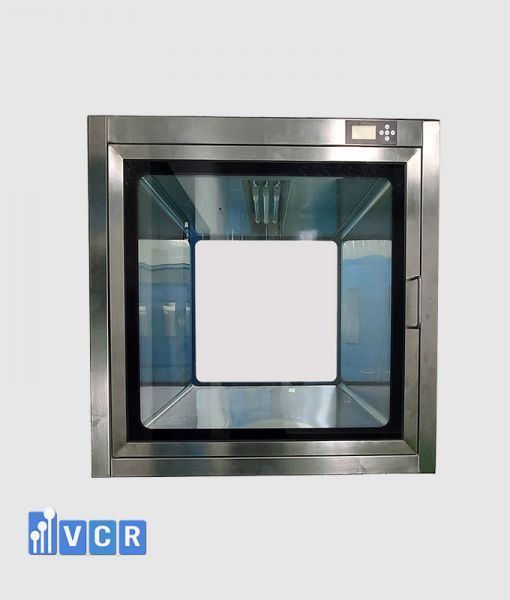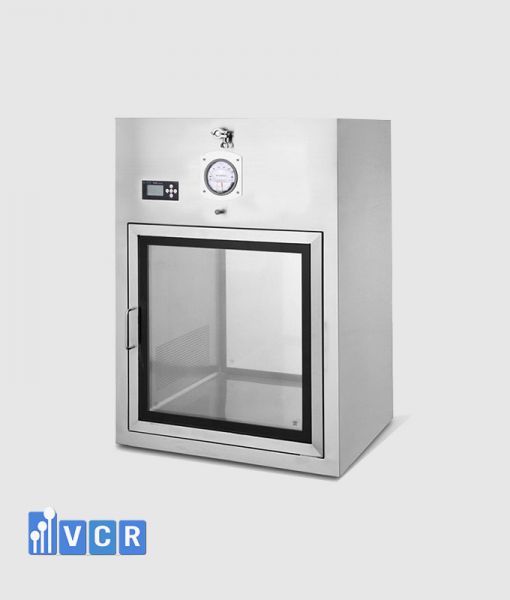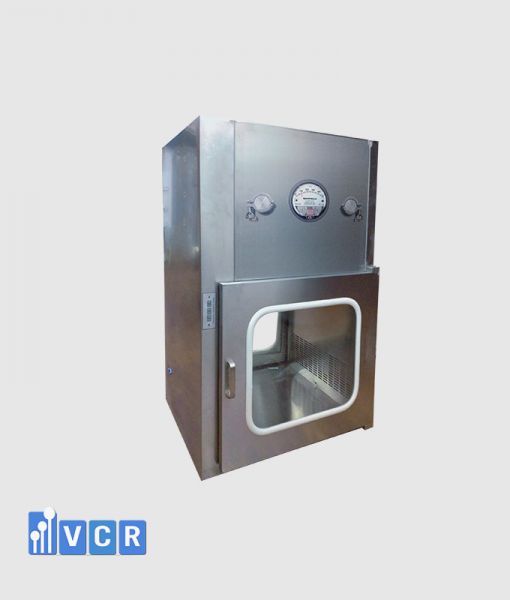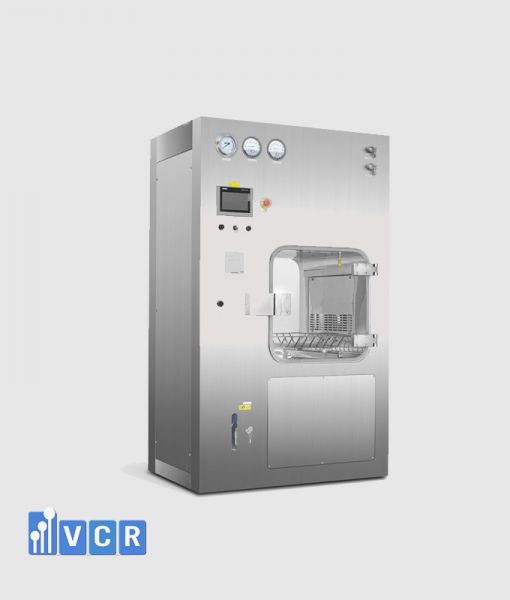

A Pass Box is an important cleanroom device that allows materials to be transferred between controlled areas without directly opening cleanroom doors. With its sealed structure, interlocking mechanism, and cross-contamination control function, it is widely used in pharmaceutical, food, cosmetics, electronics, and laboratory cleanrooms.
- The Role of a Pass Box in Cross-Contamination Control
- What Is a Pass Box?
- Why Is a Pass Box Important in Cleanrooms?
- Basic Structure of a Pass Box
- Operating Principle of a Pass Box
- Common Types of Pass Boxes
- Practical Applications of Pass Boxes in Different Industries
- Criteria for Choosing the Right Pass Box
- Common Mistakes When Using a Pass Box
- FAQ About Pass Boxes
- Conclusion: A Pass Box Is a Small Device With a Major Role in Cleanroom Control
The Role of a Pass Box in Cross-Contamination Control
In a cleanroom, every time a door opens between two areas, airflow, pressure balance, particle concentration, and cross-contamination risk may be affected. For this reason, material transfer cannot be handled casually as it would be in a normal environment. A Pass Box is designed to solve this problem by creating a dedicated transfer chamber between two areas, reducing the need for personnel to move in and out frequently.
A Pass Box is widely used in pharmaceutical factories, food production facilities, cosmetics plants, electronics manufacturing, hospitals, laboratories, and many controlled production environments. Although the equipment is not usually large in size, it plays an important role in stabilizing cleanroom conditions, reducing particle dispersion, limiting microbial contamination, and supporting controlled operating procedures.
For modern cleanroom projects, especially those required to comply with GMP (Good Manufacturing Practice), ISO 14644 (the international standard for cleanroom air cleanliness classification), or strict cross-contamination control requirements, a Pass Box is almost an essential device. Choosing the right Pass Box not only makes operation more convenient but also directly affects safety, stability, and compliance across the entire production area.
What Is a Pass Box?
A Pass Box is a device used to transfer materials, tools, raw materials, test samples, components, or documents between two areas with different cleanliness levels, or between two spaces where direct contact should be restricted. In cleanroom applications, it is commonly known as a Pass Box, meaning a transfer chamber or material transfer box installed through a cleanroom wall.
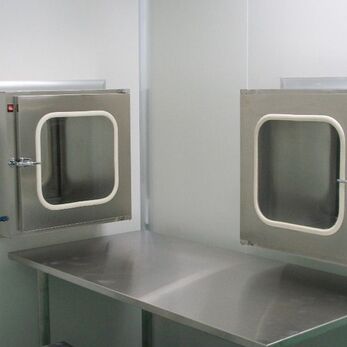
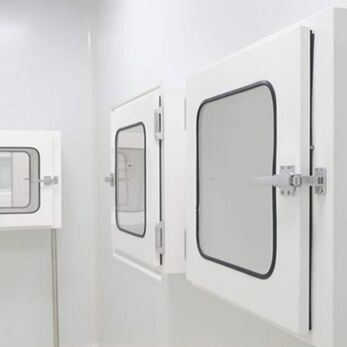
In essence, a Pass Box is a sealed chamber installed on the wall between two rooms or functional areas. It usually has two doors on opposite sides. When an operator places materials into the chamber from one side, the opposite door remains locked to prevent direct air exchange between the two areas. Once the first door is closed, the operator on the other side can open the second door to receive the materials. This mechanism helps minimize the need to open large cleanroom doors, thereby reducing airflow disturbance, particle dispersion, and cross-contamination risk.
In a normal environment, transferring items between two rooms may simply involve opening a door and passing them through. However, in a cleanroom, this simple action can affect the entire contamination control system. When a cleanroom door opens, air from outside may enter the controlled area, carrying dust, microorganisms, or unwanted particles. Conversely, if the inner area contains chemicals, odors, active pharmaceutical ingredients, or biological agents, opening the door may also allow contaminants to spread outward.
A Pass Box separates the material transfer process from personnel movement. This is very important because people are often one of the largest contamination sources in cleanrooms. With a Pass Box, personnel do not need to move repeatedly between areas, reducing the generation of particles, fibers, microorganisms, and unnecessary air movement.
A cleanroom Pass Box is usually made from stainless steel, commonly SUS 304 or SUS 316. SUS 304 is suitable for most standard cleanroom applications due to its corrosion resistance, easy-to-clean surface, and good durability. SUS 316 provides better corrosion resistance and is often used in environments involving chemicals, high humidity, or stricter technical requirements.
Depending on the application, a Pass Box may be static or dynamic. A Static Pass Box is a passive transfer box without an active fan or air filtration system. A Dynamic Pass Box is equipped with a fan, HEPA filter, and clean airflow system inside the transfer chamber. HEPA stands for High Efficiency Particulate Air, meaning a high-efficiency air filter capable of capturing very small airborne particles.
Put simply, a Pass Box is a material control point within a cleanroom system. It is not merely a box for passing items from one side to another. It is a device that supports cleanliness level maintenance, cross-contamination control, and operational discipline. Therefore, in cleanroom design drawings, the position, size, and type of Pass Box should be carefully selected according to material flow, cleanliness classification, and actual production procedures.
Why Is a Pass Box Important in Cleanrooms?
A Pass Box is important in cleanrooms because it helps control one of the most common risk points: material transfer between areas. In a factory or laboratory, materials must constantly move from one location to another. These may include incoming raw materials, production tools, packaging materials, test samples, components, documents, or consumables. If every transfer requires opening a room door or personnel movement between areas, it becomes difficult to maintain stable cleanroom conditions.
In a cleanroom, pressure differentials between areas are often designed to control airflow direction. Cleaner areas usually maintain higher pressure than less clean areas to prevent contaminated air from entering. When doors are opened frequently, pressure may fluctuate, airflow may become unstable, and particles from outside areas may enter the controlled zone. A Pass Box reduces the frequency of large door openings, helping maintain more stable pressure.
Another important role of a Pass Box is limiting cross-contamination. Cross-contamination occurs when particles, microorganisms, chemicals, active ingredients, or impurities from one area spread to another. In pharmaceutical, food, cosmetics, or medical device production, cross-contamination can directly affect product quality and user safety. Even a small amount of uncontrolled contamination can cause a production batch to fail quality requirements.
A Pass Box controls cross-contamination by creating a sealed intermediate chamber. Materials are placed inside the chamber, the first door is closed, and only then can the opposite door be opened. This prevents the two areas from being directly connected at the same time. With Pass Boxes equipped with UV lamps or HEPA filtration, contamination control can be further improved, especially when materials need to be transferred into areas with higher cleanliness requirements.
In GMP facilities, material flow, personnel flow, and process control are critical requirements. A Pass Box helps separate material movement from personnel movement. This not only makes factory operation more systematic but also supports audits, validation, and compliance assessment.
Under ISO 14644, airborne particle concentration is one of the core factors used to classify cleanroom cleanliness. Each door opening, uncontrolled material transfer, or unnecessary movement may increase particle levels in the air. A Pass Box does not replace the HVAC system, meaning the Heating, Ventilation, and Air Conditioning system, but it is an important supporting component that reduces particle generation risks during operation.
In real cleanroom construction projects, many contractors pay close attention to Pass Boxes because they are directly related to wall panel layout, material flow, installation height, electrical requirements, interlock systems, and handover requirements for the project owner. As a cleanroom equipment supplier for cleanroom construction contractors, Thiết bị phòng sạch VCR often advises on Pass Box selection based on actual operating needs, cleanliness level, material size, and cross-contamination control requirements of each project.
A Pass Box may be small, but it has a significant impact on cleanroom stability. When selected, installed, and operated properly, it reduces many risks in material transfer. On the other hand, if the wrong type, wrong size, or an unsuitable interlock mechanism is chosen, the Pass Box may become a weak point in the entire cleanroom contamination control system.
Basic Structure of a Pass Box
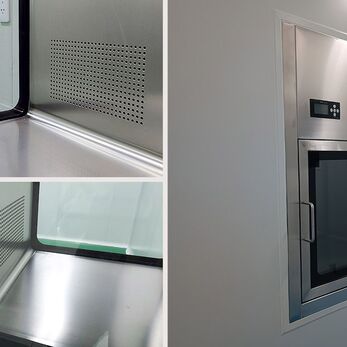
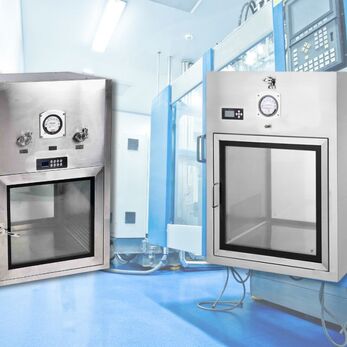
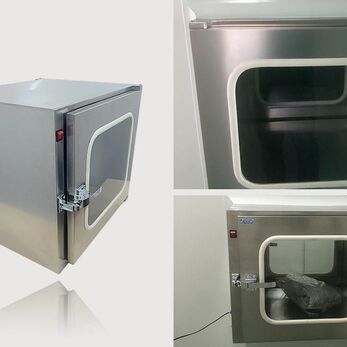
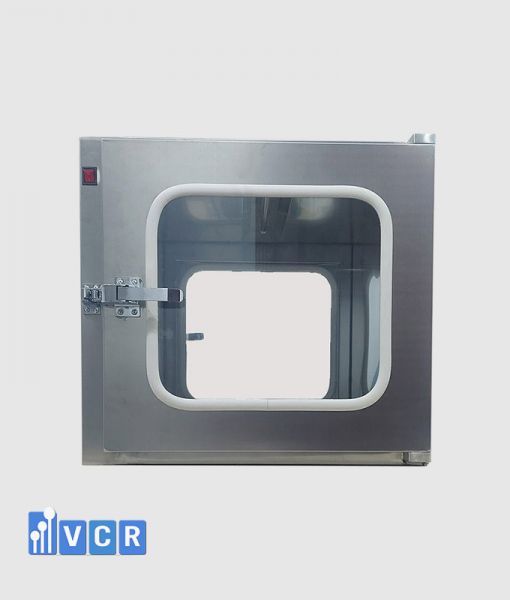
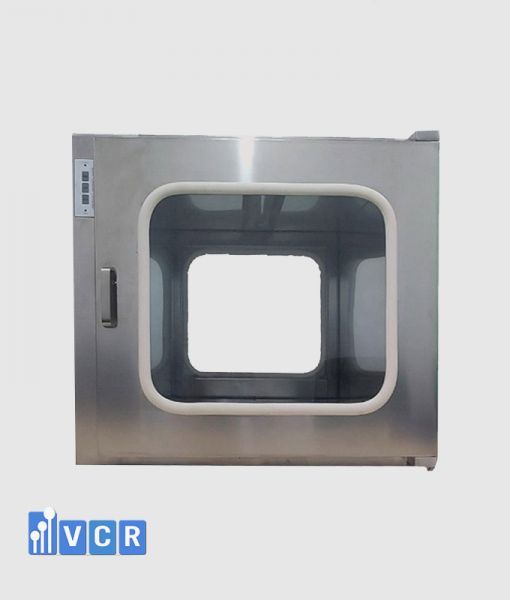
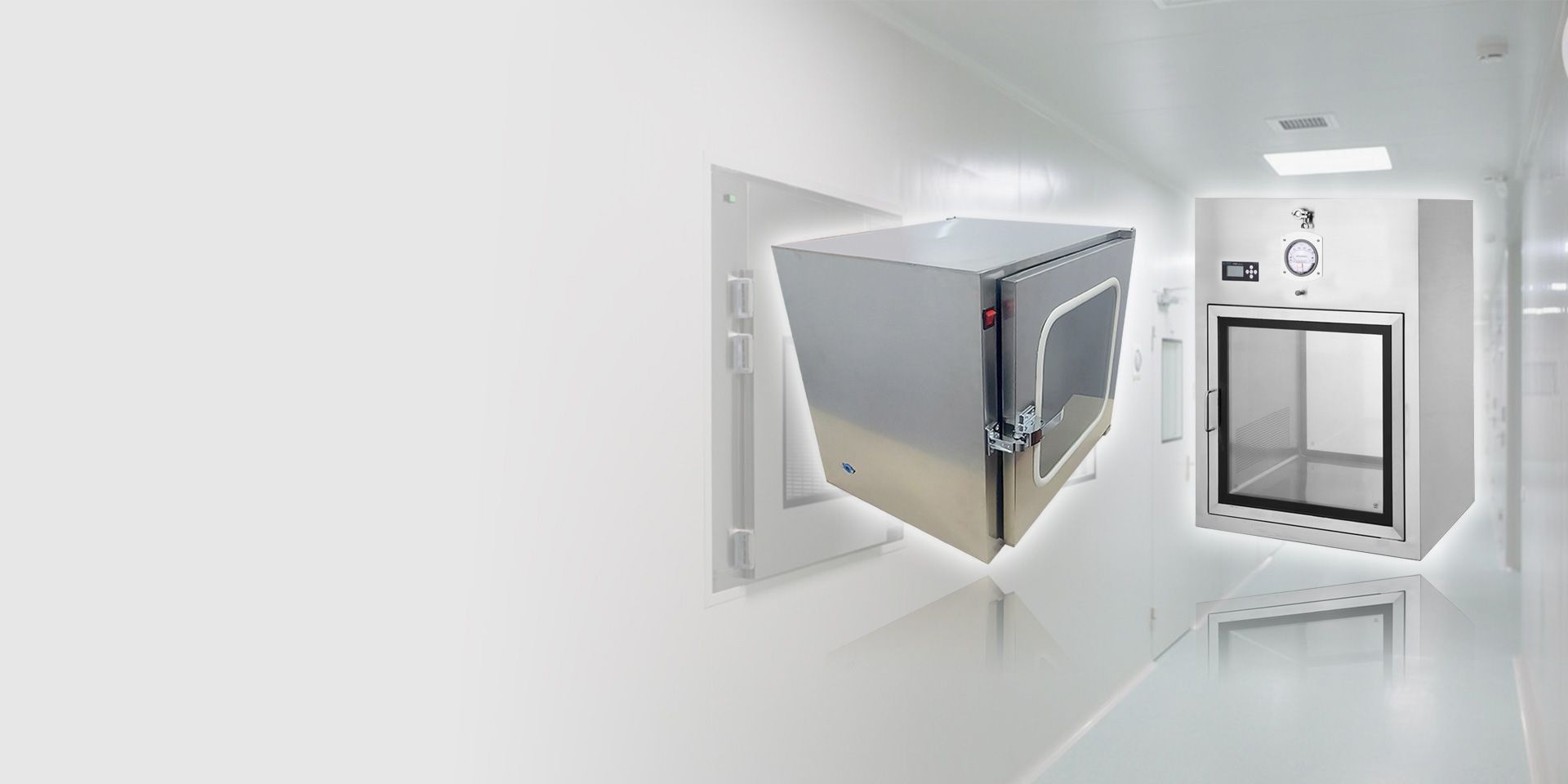
The structure of a Pass Box may vary depending on the equipment type, cleanliness requirements, and project specifications. However, a standard Pass Box usually includes a main body, transfer chamber, two doors, viewing glass, sealing gasket, interlock system, lighting, UV lamp if required, control panel, and HEPA filtration system for dynamic models.
The main body forms the primary structure of the Pass Box. Stainless steel is the most common material because it has a smooth, durable, easy-to-clean surface and generates minimal particles. SUS 304 is widely used for common cleanroom applications such as food, cosmetics, electronics, and many pharmaceutical production areas. SUS 316 is preferred in environments with chemicals, high corrosion risk, or stricter material requirements. In cleanrooms, materials must not only be durable but also easy to clean, non-particle-shedding, and resistant to becoming a contamination source.
The transfer chamber is the internal space used to place materials. It acts as an intermediate zone between two areas. The chamber size should be selected based on the materials frequently transferred through it. If the chamber is too small, operators may struggle to handle items or need to divide transfers into multiple steps. If the chamber is too large, the device occupies more space, increases cost, and may not fit the cleanroom wall design efficiently. Therefore, Pass Box selection should consider the largest material size, transfer frequency, and installation position.
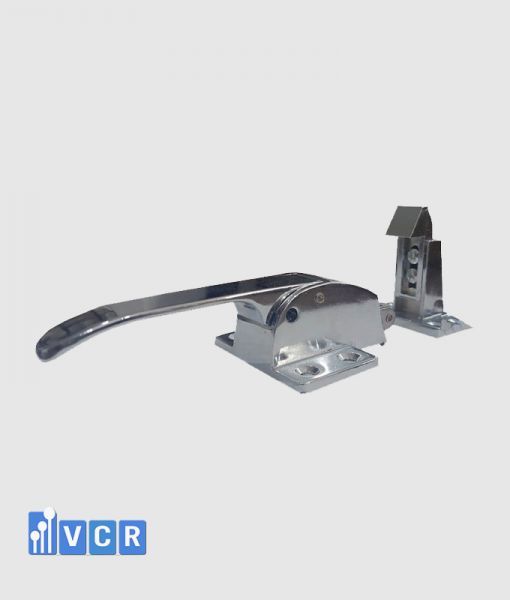
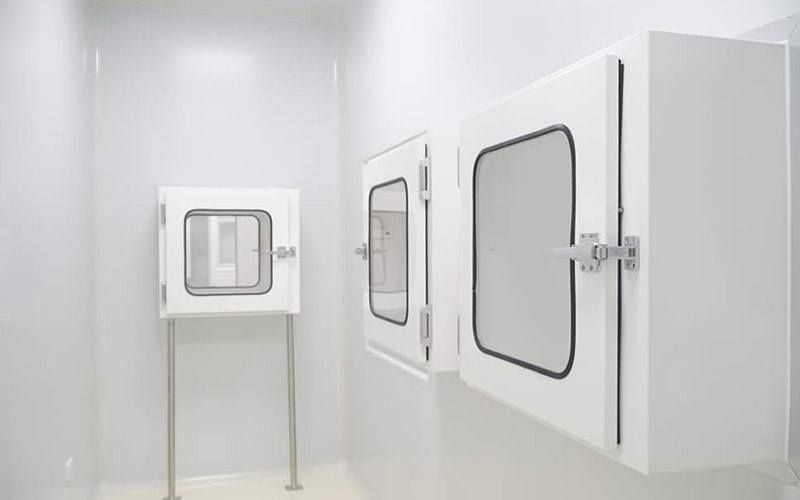
The two doors are the key identifying feature of a Pass Box. They are usually installed opposite each other so materials can move from one side to the other. Some special designs may use angled or customized door arrangements depending on the layout, but the most common design remains two opposite doors. Doors may be made of stainless steel, glass, or stainless steel combined with viewing glass. Viewing glass allows operators to check the chamber condition before opening the door, making operation safer and more convenient.
The sealing gasket is a small but important component. It is usually installed around the door edges to improve sealing when the door is closed. If the gasket is loose, cracked, deformed, or improperly installed, air may leak through the door gap and reduce cross-contamination control performance. In cleanrooms, sealing performance is always important because even a small leakage point may affect pressure and local airflow.
The interlock system ensures that both doors cannot be opened at the same time. Interlock means a mechanism that links door operation to prevent simultaneous opening. This is one of the most important features of a cleanroom Pass Box. If both doors open at once, the transfer chamber no longer functions as an airlock buffer, and the two areas may exchange air directly. The interlock may be mechanical or electronic. A mechanical interlock is simple, easy to use, and less dependent on electricity. An electronic interlock can be integrated with a control panel, indicator lights, timer, and advanced safety functions.
Internal lighting helps operators see materials clearly inside the transfer chamber, especially in areas with limited light or when checking material status before receiving. UV lamps may be installed in some Pass Box models to support surface disinfection. UV means ultraviolet light, which can help reduce microorganisms on exposed surfaces under suitable conditions. However, UV does not completely replace manual cleaning procedures. Its effectiveness depends on exposure time, distance, lamp intensity, surface cleanliness, and direct light contact with the target area.
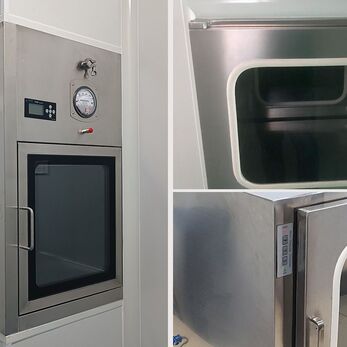
A control panel is commonly found in Pass Boxes with electronic interlock, UV lamp, lighting, fan, or HEPA filter. It allows operators to monitor door status, turn lights on or off, set disinfection time, or control equipment functions. In production environments requiring standardized operation, a control panel helps make operation more consistent and reduces dependence on individual operator habits.
For Dynamic Pass Boxes, the fan and HEPA filter system are very important. The fan creates circulating airflow or clean airflow through the transfer chamber, while the HEPA filter captures airborne particles. This allows the chamber to maintain a cleaner environment than a static model. Some designs also include a differential pressure gauge to monitor filter status. When pressure difference rises abnormally, it may indicate that the filter is loaded and needs inspection or replacement.
Overall, the structure of a Pass Box must serve three main purposes: ensuring sealing performance, enabling convenient material transfer, and supporting cross-contamination control. A good Pass Box is not only visually well-finished but also strong, easy to clean, suitable for operating procedures, and compatible with cleanroom construction. Therefore, cleanroom contractors often need to coordinate with equipment suppliers such as Thiết bị phòng sạch VCR to select the right size, material, door type, interlock mechanism, and functional configuration from the early project stage.
Operating Principle of a Pass Box
The operating principle of a Pass Box is based on creating a sealed intermediate chamber between two areas. Instead of opening a cleanroom door to transfer materials directly from outside to inside, the operator places the materials into the Pass Box. After the loading-side door is closed, the receiving-side door can then be opened. This process prevents the two areas from being directly connected at the same time, reducing uncontrolled airflow, particles, and microorganisms.
In a basic operation, the operator in the first area opens one Pass Box door, places the materials inside the chamber, and closes the door. Once the door is fully closed, the interlock system allows the opposite door to open. The operator in the second area opens the door, removes the materials, and closes it again. The entire process is designed to ensure that only one door can open at any given time. This is the key principle that makes a Pass Box different from a simple opening in a wall.
The interlock mechanism keeps the process safe. Without an interlock, operators may accidentally open both doors at once, causing the device to lose its contamination control function. With a mechanical interlock, operation is usually based on a physical mechanism that prevents the second door from opening while the first is open. With an electronic interlock, sensors and controllers identify door status and then allow or prevent the opposite door from opening. Some systems also include indicator lights so operators can clearly see which door is permitted to open.
For a Static Pass Box, the operating principle mainly depends on the sealed chamber and interlock system. The device does not generate active clean airflow, so it is often suitable for areas with similar cleanliness levels or basic control requirements. Static Pass Boxes are commonly used to transfer materials between two rooms with relatively similar environmental conditions, or when materials have already been cleaned and packaged before transfer.
For a Dynamic Pass Box, the operating principle includes a fan and air filtration system. A Dynamic Pass Box can generate airflow through a HEPA filter to reduce airborne particles inside the transfer chamber. When materials are placed inside, the chamber air can be recirculated through the filter or directed according to the design to reduce particle accumulation. This provides better control than a Static Pass Box, especially in areas requiring higher cleanliness levels.
Some Pass Boxes are equipped with UV lamps for disinfection support. When materials are placed in the chamber, the operator can close the door and activate UV mode for a set period. UV light can help reduce microorganisms on surfaces exposed directly to the light. However, this principle is only effective when surfaces are not blocked and exposure time is sufficient. If materials have many hidden areas, uneven surfaces, or dust covering the surface, UV effectiveness will decrease. Therefore, UV should be considered a supporting tool, not the only method for ensuring cleanliness.
In strict production processes, Pass Box operation may be controlled by an SOP. SOP stands for Standard Operating Procedure, meaning a documented procedure that defines the correct operating steps. The SOP usually specifies who is allowed to use the device, what materials can be transferred, how materials should be cleaned before transfer, waiting time, UV exposure time, chamber cleaning method, and how to record abnormalities. As a result, the Pass Box becomes not only a mechanical device but also part of the quality management system.
Proper Pass Box operation requires both correct equipment design and operator discipline. If operators keep doors open too long, overload the chamber, fail to close doors properly, or skip cleaning procedures, contamination control effectiveness will decrease. When used correctly, however, a Pass Box makes material movement safer, clearer, and easier to control.
Common Types of Pass Boxes
There are many types of Pass Boxes available today, but the most common include Static Pass Box, Dynamic Pass Box, UV Pass Box, mechanical interlock Pass Box, electronic interlock Pass Box, and stainless-steel Pass Boxes customized for specific project requirements. Each type has different characteristics and is suitable for different levels of control, budgets, and operating environments.
A Static Pass Box is a passive transfer chamber. It has a relatively simple structure, usually including a stainless-steel body, two doors, viewing glass, sealing gasket, and interlock system. Because it does not have a fan or active air filtration system, a Static Pass Box is suitable for areas with similar cleanliness levels or basic cross-contamination control requirements. Its advantages include reasonable cost, easy installation, simple operation, and low maintenance requirements. This type is commonly used in food, cosmetics, electronics, and cleanroom supporting areas.
A Dynamic Pass Box is usually equipped with a fan, HEPA filter, and control system. It can generate clean airflow inside the transfer chamber, helping reduce particle levels when materials are transferred. A Dynamic Pass Box is more suitable for areas with higher cleanliness requirements or when materials are transferred from a less clean area into a cleaner area. Compared with a Static Pass Box, the dynamic type costs more and requires maintenance for filters, fans, differential pressure gauges, and electrical components. However, its air cleanliness control inside the chamber is also better.
A UV Pass Box is used when surface disinfection support is required. UV lamps are usually installed inside the chamber and may operate according to a preset time. However, when selecting this type, users need to understand the limitations of UV. UV only works effectively on surfaces directly exposed to the light. It cannot penetrate thick packaging, does not treat hidden areas well, and cannot replace prior cleaning. Therefore, a UV Pass Box should be used together with proper cleaning and operating procedures.
A mechanical interlock Pass Box is suitable for applications that require simplicity and stability. The mechanical interlock does not depend heavily on electrical systems, is easy to use, and has fewer failure points. However, it usually has fewer functions than an electronic interlock. For projects requiring door status indication, indicator lights, or integration with a control panel, an electronic interlock is more suitable.
An electronic interlock Pass Box controls door status through sensors and a controller. When one door is open, the other door remains locked. The system may include indicator lights, alarms, timers, UV control, fan control, and other operating functions. This type is suitable for cleanrooms with stricter operating requirements, where reducing operator error and clearly displaying equipment status are important.
In addition to standard models, many projects require Pass Boxes with customized dimensions. For example, a factory may need to transfer large trays, containers, long components, bulky packaging, or special materials. In such cases, the equipment must be designed according to actual material size while still ensuring sealing performance, durability, cleanability, and compatibility with cleanroom walls. If a project simply chooses a standard model without considering actual materials, operation may become difficult later.
During selection, the key question should not be only which model is cheaper, but which model is more suitable for contamination risk and control requirements. If the area only transfers materials between two rooms of similar cleanliness, a Static Pass Box may be sufficient. If stricter particle control is required, a Dynamic Pass Box should be considered. If surface disinfection support is needed, UV may be added, but only with the right operating procedure.
Thiết bị phòng sạch VCR often advises cleanroom construction contractors based on layout, cleanliness class, material flow, and the owner’s operating requirements. This helps Pass Box selection go beyond basic product specifications and become part of a complete cleanroom solution.
Practical Applications of Pass Boxes in Different Industries
Pass Boxes are used in many industries and research fields. The common purpose across these applications is the need to transfer materials between areas without affecting internal environmental conditions. Depending on the industry, transferred items may include raw materials, test samples, tools, packaging, components, documents, or production supplies.
In the pharmaceutical industry, Pass Boxes are commonly used to transfer cleaned raw materials, packaging, production tools, test samples, or supplies between areas with different cleanliness levels. This industry has very high requirements for cross-contamination control, process traceability, and GMP compliance. Without a Pass Box, bringing materials into clean areas may increase the risk of particles, microorganisms, or impurities entering the production process.
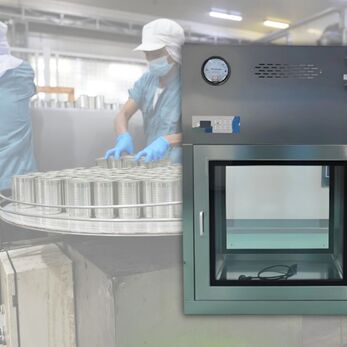
In the food industry, Pass Boxes support the transfer of tools, packaging materials, quality control samples, or supplies into hygienic processing areas. For factories producing functional foods, beverages, dairy products, confectionery, or packaged foods, hygiene control and cross-contamination prevention are very important. A Pass Box reduces the need to open processing area doors, helping maintain hygienic conditions and reduce contamination risk.
In cosmetics manufacturing, Pass Boxes are used in formulation, filling, packaging, and quality control areas. Since cosmetics come into direct contact with skin, production must control dust, microorganisms, and impurities properly. Using a Pass Box helps organize material flow more clearly, especially when transferring bottles, caps, packaging, tools, or samples between areas.
In electronics and semiconductor manufacturing, Pass Boxes not only help control dust but also protect components from airborne particles. Electronic components, circuit boards, sensors, and semiconductor parts can be affected by very small particles. Transferring components through a Pass Box reduces exposure to outside environments and limits unwanted particle intrusion. In high-cleanliness areas, a Dynamic Pass Box with HEPA filtration is usually more suitable.
In hospitals and healthcare facilities, Pass Boxes may be used in isolation areas, laboratories, drug preparation rooms, sterile areas, or supporting zones near operating rooms. The device helps transfer samples, tools, or supplies without opening a direct door between areas with different risk levels. This is especially useful for hospital infection control and healthcare worker protection.
In laboratories, Pass Boxes help transfer samples, tools, or supplies between preparation areas and working areas. Some biological or chemical laboratories need to limit the release of hazardous agents to the outside. In such cases, the Pass Box adds an additional control layer and makes operation safer. For rooms with high biological risk, more specialized systems may also be required, such as BIBO, meaning Bag In Bag Out, a safe filter replacement system using protective bags, or other appropriate biosafety solutions.
In medical device manufacturing, Pass Boxes are used to transfer components, packaging, semi-finished products, or supplies into clean assembly areas. Medical devices often need to be manufactured under controlled conditions to ensure safety during use. A Pass Box supports controlled material flow, reduces door openings, and helps stabilize production.
The application of a Pass Box is not simply about passing items from one side to another. It is about organizing material flow in a controlled manner. A well-designed factory clearly separates personnel flow, material flow, waste flow, and finished product flow. The Pass Box is one of the key control points in these flows, helping materials move in the right direction, according to the right procedure, with minimal impact on the production environment.
For cleanroom construction contractors, selecting the right Pass Box from the beginning makes installation smoother and reduces the risk of wall modifications, size changes, or equipment additions after completion. Thiết bị phòng sạch VCR can support contractors in choosing Pass Boxes according to each industry, drawing, and technical requirement from the project owner.
Criteria for Choosing the Right Pass Box
Choosing the right Pass Box requires considering multiple criteria, not just price. A low-cost device that fails to meet requirements for size, sealing, material, or cleanliness may create operational difficulties and increase cross-contamination risk. Conversely, a configuration that is too advanced for actual needs may increase unnecessary investment and maintenance costs.
The first criterion is transfer chamber size. The chamber must fit the largest materials commonly transferred. If a factory frequently transfers trays, boxes, small containers, or fixed-size components, actual measurements should be taken before selecting the device. The chamber should be spacious enough for convenient handling, but not so large that it occupies excessive space or becomes difficult to install on the wall.
The second criterion is material. SUS 304 stainless steel is suitable for most standard cleanroom applications because it is durable, easy to clean, resistant to corrosion, and cost-effective. SUS 316 is more suitable for environments involving chemicals, moisture, strong cleaning agents, or higher technical requirements. The stainless-steel surface should be smooth, minimize dead corners, and be easy to wipe clean so dust and dirt do not accumulate.
The third criterion is the interlock type. For basic control areas, a mechanical interlock may be sufficient. For areas requiring clear door status control, indicator lights, UV control, or fan control, an electronic interlock is more appropriate. Whether mechanical or electronic, the most important purpose is to ensure that both doors cannot open at the same time.
The fourth criterion is air filtration requirement. Not every case requires a Dynamic Pass Box. If the two areas have similar cleanliness levels and materials are already well controlled before transfer, a Static Pass Box may be a reasonable choice. However, if materials need to move from a less clean area into a cleaner area, or if the receiving area has strict particle control requirements, a Dynamic Pass Box with HEPA filtration should be considered.
The fifth criterion is UV disinfection demand. If the process requires support for reducing microorganisms on material surfaces, UV can be a useful feature. However, users must properly evaluate material characteristics, packaging method, exposure time, and UV contact conditions. UV should not be selected simply because it “feels safer” without having a suitable operating procedure.
The sixth criterion is installation position. Pass Boxes are usually mounted through the wall between two areas, so operation height, door opening direction, available space on both sides, wall structure, and maintenance access must be considered. If the device is installed too high or too low, operation becomes inconvenient. If the door opening direction conflicts with walkways or nearby equipment, daily use will be difficult.
The seventh criterion is cleanliness class and project standards. GMP, ISO 14644, and internal project requirements often define clear expectations for materials, cleanability, cross-contamination control, and operation. The Pass Box should be selected to match these requirements. For export-oriented factories or facilities following international standards, choosing the right equipment from the beginning is even more important.
The eighth criterion is maintainability. A good Pass Box should be easy to clean, easy to inspect for gasket condition, easy to replace UV lamps if present, easy to check the interlock, and easy to access maintenance points. For Dynamic Pass Boxes, filter service life, differential pressure gauge, fan, and electrical control system should also be considered.
When advising contractors, Thiết bị phòng sạch VCR usually considers both technical requirements and actual construction conditions. A suitable device must not only meet specifications but also match drawings, wall dimensions, installation schedule, and post-handover operation. This is why cleanroom contractors should work early with the equipment supplier to avoid deviations during project implementation.
Common Mistakes When Using a Pass Box
Although a Pass Box has a relatively simple operating principle, many usage mistakes can reduce its effectiveness. The most common mistake is opening both doors at the same time or interfering with the interlock mechanism. When both doors open simultaneously, the Pass Box no longer functions as a buffer zone, and air between the two areas may exchange directly. This behavior must be strictly controlled in cleanrooms.
The second mistake is failing to clean the transfer chamber regularly. Materials passing through the Pass Box every day may carry dust, packaging particles, small material fragments, or microorganisms on their surfaces. If the chamber is not cleaned regularly, the device itself may become a contamination accumulation point. Therefore, a clear cleaning schedule and suitable wiping materials should be defined for the area.
The third mistake is over-relying on UV lamps. Some users assume that turning on UV means the materials are completely clean. This is not accurate. UV only supports surface disinfection under suitable conditions, with direct exposure and sufficient time. If materials are dusty, dirty, or have hidden surfaces, UV effectiveness will be significantly reduced. UV must be combined with cleaning, packaging, and material control procedures before transfer.
The fourth mistake is choosing the wrong Pass Box size. If the chamber is too small, operators may need to tilt, squeeze, or awkwardly rotate materials, increasing the risk of contact and contamination. If the chamber is too large, the equipment takes up more space, increases cost, and may complicate installation. Chamber size should be determined based on actual materials, not estimation alone.
The fifth mistake is blocking airflow inside a Dynamic Pass Box. For dynamic models, clean airflow must circulate properly inside the chamber. If materials are too large, placed incorrectly, or overloaded, airflow may be blocked, reducing filtration and particle control effectiveness. Operators should be trained on correct material placement inside the chamber.
The sixth mistake is neglecting door gasket inspection. Gaskets may age, deform, or become dirty over time. If the gasket does not seal properly, the door may appear closed while still allowing leakage, reducing control effectiveness. In strict areas, door gaskets should be inspected regularly and replaced when damaged.
The seventh mistake is failing to maintain the interlock system. The interlock protects the core operating principle of the equipment. If it becomes jammed, loose, damaged, or slow to respond, operators may experience difficulties or use the device incorrectly. For electronic interlocks, sensors, power supply, indicator lights, and the control panel should also be checked.
The eighth mistake is using the wrong Pass Box type for the required cleanliness level. Some areas require a Dynamic Pass Box but use a Static Pass Box to reduce cost. This may increase particle and contamination risks during material transfer. Conversely, some areas only need a Static Pass Box but are equipped with unnecessarily complex devices, increasing maintenance costs.
To avoid these mistakes, businesses should establish clear operating procedures, train operators, and inspect equipment regularly. A Pass Box is only effective when it is designed correctly, installed correctly, and used correctly. This is an important point that contractors and project owners should align on from the cleanroom design stage.
FAQ About Pass Boxes
Is a Pass Box mandatory in cleanrooms?
A Pass Box is not always mandatory in every cleanroom, but in areas requiring cross-contamination control, it should be strongly considered. When materials need to move between areas with different cleanliness levels, a Pass Box helps reduce direct door opening, limit pressure disturbance, and better control material flow. For pharmaceutical, food, cosmetics, electronics, or medical device factories, Thiết bị phòng sạch VCR often recommends that contractors consider the Pass Box as an important part of the overall cleanroom solution.
What is the difference between a Pass Box and an Air Shower?
A Pass Box is used to transfer small materials through a wall between two areas, while an Air Shower is a clean air shower chamber generally used to remove dust from personnel or large items before they enter a cleanroom. A Pass Box focuses on reducing door opening and controlling material flow. An Air Shower uses high-velocity clean air jets to blow particles off surfaces. In many projects, both devices may be used together depending on personnel flow and material flow design.
When should a Static Pass Box be used?
A Static Pass Box should be used when transferring materials between areas with similar cleanliness levels or when contamination control requirements are basic. This type does not have an active fan or HEPA filter, but it still has a sealed chamber and interlock system to prevent direct connection between the two areas. A Static Pass Box is a practical option for factories that need a simple, durable, easy-to-operate, and cost-effective transfer solution. When contractors are unsure which type to choose, they can consult Thiết bị phòng sạch VCR based on the actual layout.
When should a Dynamic Pass Box be used?
A Dynamic Pass Box should be used when stronger particle control is required and when a cleaner environment inside the transfer chamber is needed. The device includes a fan and HEPA filter, allowing air inside the chamber to be filtered before or during material transfer. This type is suitable for areas with higher cleanliness requirements, especially when materials are transferred from a less clean area into a cleaner area. A Dynamic Pass Box usually requires higher investment and maintenance, but it offers better control for stricter cleanroom projects.
Can the UV lamp in a Pass Box replace manual cleaning?
The UV lamp in a Pass Box cannot replace manual cleaning. UV, or ultraviolet light, only supports surface disinfection under suitable conditions, when the light directly reaches the surface for a sufficient amount of time and the surface is not blocked. If materials are dusty, dirty, or have hidden areas, UV effectiveness decreases significantly. Businesses still need to maintain cleaning, packaging, and material control procedures before using the Pass Box. UV should be considered a supporting feature, not the only solution for cleanliness assurance.
Should a Pass Box be made from SUS 304 or SUS 316 stainless steel?
SUS 304 stainless steel is suitable for most standard cleanroom applications because it is durable, easy to clean, corrosion-resistant, and cost-effective. SUS 316 provides higher corrosion resistance and is suitable for environments involving chemicals, moisture, strong cleaning agents, or stricter technical requirements. Material selection should not be based only on price. It should consider the industry, cleaning process, corrosion risk, and project owner requirements. Thiết bị phòng sạch VCR can support contractors in choosing the right material for each project.
Conclusion: A Pass Box Is a Small Device With a Major Role in Cleanroom Control
A Pass Box is one of the basic yet highly important devices in cleanroom systems. It helps transfer materials between two areas without directly opening cleanroom doors, thereby supporting pressure stability, reducing airflow disturbance, limiting particles, and controlling cross-contamination. In industries such as pharmaceuticals, food, cosmetics, electronics, medical devices, hospitals, and laboratories, the Pass Box provides not only convenience but also better product quality protection and production environment safety.
A suitable Pass Box should be selected based on cleanliness level, material type, transfer frequency, installation position, material of construction, interlock type, and air filtration requirements. A Static Pass Box is suitable for basic control needs, while a Dynamic Pass Box is more appropriate for areas requiring stricter particle control. UV lamps, electronic interlocks, HEPA filters, and additional functions should be considered according to actual risk rather than chosen by assumption.
Most importantly, the Pass Box should be treated as part of the overall cleanroom solution. It only performs effectively when installed in the right position, constructed properly, operated according to procedure, and maintained regularly. For cleanroom construction contractors, early coordination with an equipment supplier helps reduce dimensional errors, avoid installation issues, and ensure that the device meets handover requirements.
As factories increasingly focus on GMP, ISO 14644, and quality control standards, the Pass Box continues to play an important role in organizing safe material flow. It is not merely an auxiliary device. It is a practical control point that helps cleanrooms operate more stably, safely, and professionally.
If you need to select a Pass Box for a pharmaceutical, food, cosmetics, electronics, hospital, laboratory, or medical device cleanroom project, Thiết bị phòng sạch VCR can support you in choosing a suitable configuration based on drawings, cleanliness level, and actual operating requirements.
As a cleanroom equipment supplier for cleanroom construction contractors, Thiết bị phòng sạch VCR not only provides products but also supports the selection of materials, dimensions, door types, interlock systems, air filtration requirements, UV functions, and installation solutions. Each cleanroom project has its own characteristics, so Pass Box selection should be based on both technical standards and post-handover operating conditions.
Contact Thiết bị phòng sạch VCR for consultation on the right Pass Box for your project, from Static Pass Box and Dynamic Pass Box to customized stainless-steel Pass Box configurations. Choosing the right solution from the beginning helps contractors install more smoothly, helps project owners operate more safely, and helps cleanroom systems achieve better long-term contamination control.